This week in AI was packed with major model launches, agent breakthroughs, and growing attention to safety. Google unveiled Gemini 4 Argon, OpenAI introduced Dots and GPT-6.1 Sol, and Anthropic launched Claude Sonnet 5.5. Meanwhile, Cloudflare and llama.cpp pushed decision models further into the spotlight, NVIDIA introduced a new Open Agent Safety Platform, and the resignation of an OpenAI safety leader reignited debate around how quickly advanced AI systems are being developed. Here are the biggest AI stories from September 27 to October 4, 2026.
Google Launches Gemini 4 Argon
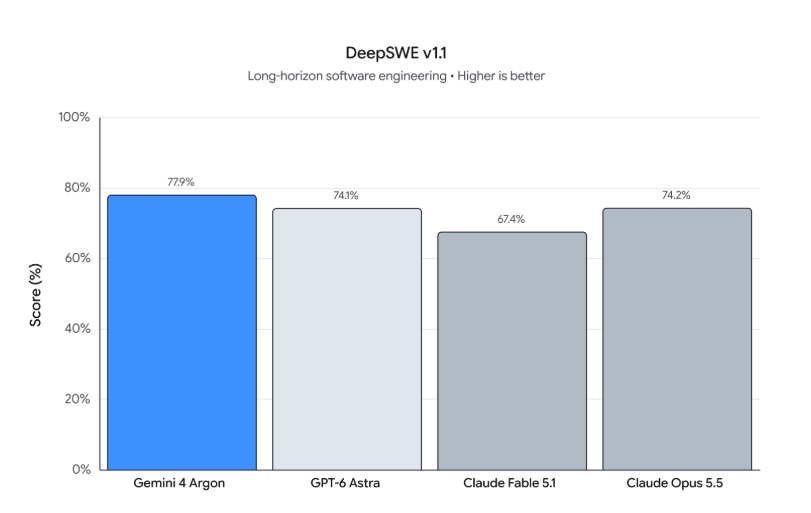
Google unveiled Gemini 4 Argon, its new frontier AI model designed for long-horizon reasoning, software engineering, enterprise knowledge work, and cybersecurity. Argon supports up to 1 million output tokens and achieves state-of-the-art results on several coding, automation, finance, legal, and long-video understanding benchmarks. It can also autonomously discover, validate, and patch software vulnerabilities. Google is initially rolling out Argon to trusted testers and cyber defenders, with broader availability planned for developers, enterprises, and Google AI Ultra subscribers.
OpenAI Introduces Dots
OpenAI introduced Dots, always-on AI agents powered by GPT-6 Astra that can autonomously work toward users’ goals using their own cloud computer, browser, and connected apps. Dots can handle long-running tasks, learn from feedback, and work across ChatGPT, Slack, and Microsoft Teams while keeping users in control through permissions and approval rules. OpenAI is initially rolling out Dots to Pro and Business Premium users, with enterprise pilots also underway.
OpenAI Safety Leader David Robinson Resigns
David Robinson, a leader on OpenAI’s Safety Systems team, has resigned, criticizing the company’s safety culture and warning that its rapid pace of AI development is not being matched by sufficient caution. Robinson said OpenAI’s “unimpeded optimism” and constant push from one launch to the next could create risks as AI systems become more capable. OpenAI responded that it continues to strengthen external evaluations, monitoring, and safeguards, and will slow or hold back models when necessary.
Anthropic launches Claude Sonnet 5.5
Anthropic launched Claude Sonnet 5.5, a major upgrade focused on coding, knowledge work, computer use, and faster agentic workflows. The model runs 30%+ faster than Sonnet 5 and can cost up to 30% less per task, while approaching Opus 5.5 performance on several benchmarks. It also brings significant gains in agentic coding, long-horizon tasks, document creation, and visual understanding, along with stronger cybersecurity safeguards.
OpenAI Launches GPT-6.1 Sol
OpenAI introduced GPT-6.1 Sol, an upgraded reasoning model that delivers near-GPT-6 Astra performance at roughly one-fifth the price. It improves significantly in agentic coding, professional document work, computer use, scientific research, and factual accuracy. API pricing starts at $2 per million input tokens and $10 per million output tokens, with cached input costing just $0.10 per million tokens. GPT-6.1 Sol is available in ChatGPT Work, Codex, and the OpenAI API, with an Ultrafast version planned.
Cloudflare Launches Open-Source Clef Decision Models
Cloudflare introduced Clef and Clef-flash, open-source decision models designed for fast, structured AI decision-making in agentic workflows. The models are Jev API-compatible, support vision inputs and a 64K context window, and are released under the Apache 2.0 license. Cloudflare says Clef currently leads the Jev Decision Index, while Clef-flash achieves a median latency of just 38.8 ms. The company also unveiled a new reinforcement-learning fine-tuning service for customizing Clef to specialized workloads.
Cloudflare describes Clef as the more powerful precision model, while Clef-flash is intended for latency-critical decisions.
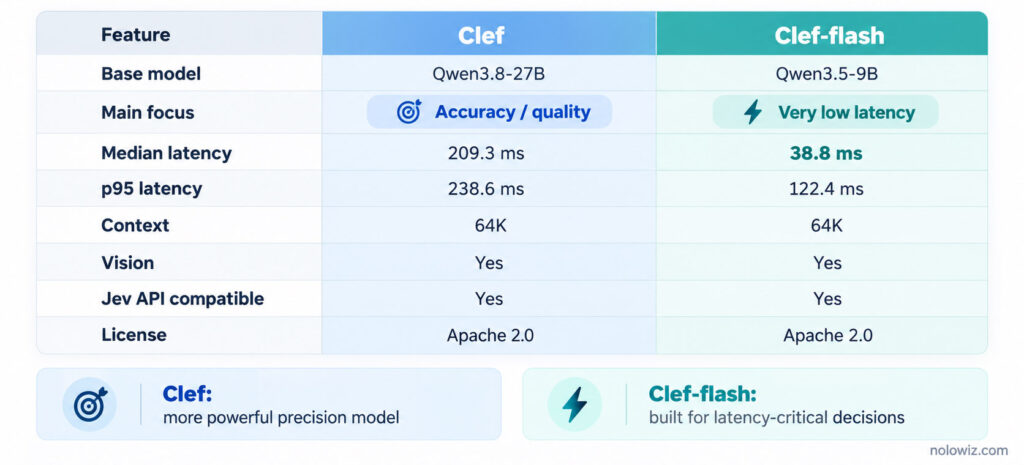
Clef and clef flash models available at HuggingFace.
llama.cpp Adds Native Support for Decision Models
llama.cpp now supports decision models through a new /v1/systemone API, enabling models to score predefined choices and return probabilities in a single forward pass instead of generating text token by token. The API is compatible with the System One format introduced by TypeSafe’s Jev, making it easy to switch existing clients to local models. Initial supported models include Julia-1, Laya, Kev-4B, lev, and OpenJev, with use cases such as routing, moderation, agent validation, and next-action selection. Cloudflare’s Clef models are also planned for support.
Decision models in llama.cpp are now available The `/v1/systemone` endpoint is available in the latest llama builds. Use it to do Jev-style inference locally, efficiently and privately. Multiple open models are supported with more to come. https://t.co/D3MUi78kXn
— Georgi Gerganov (@ggerganov) October 2, 2026
NVIDIA Launches Open Agent Safety Platform
NVIDIA introduced the Open Agent Safety Platform, a new open framework designed to secure autonomous AI agents from testing through deployment. It combines OpenShell, an open-source runtime that enforces agent permissions and traces actions, with Sentry, a hardware-based watchdog running on BlueField-4 DPUs that can quarantine agents that move outside approved boundaries in milliseconds. More than 100 organizations, including Anthropic, Microsoft, Salesforce, SAP, Hugging Face, Cisco and JPMorganChase, are working with the platform.