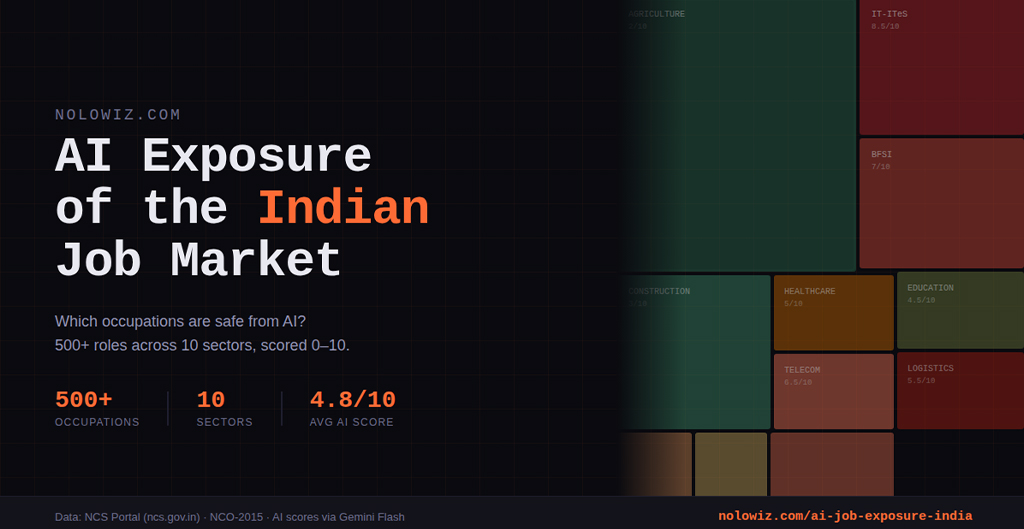
Everyone is talking about AI taking jobs. But most of that conversation is about America.
What about India – where 1.4 billion people work across farming, construction, IT, banking, healthcare, and government? Where does AI actually threaten livelihoods, and where is the workforce relatively safe?
I wanted to see this visually. So I built it. Inspired by Andrej Karpathy’s jobs project which analyzed 342 US occupations from BLS data – I built the Indian version using NCS Portal data. You can visit here .
What the map shows
The visualization is an interactive treemap of the Indian job market, covering 10 major sectors and ~500 occupations from the National Career Service portal , India’s official government career database based on NCO-2015 classification.
Each rectangle is one occupation. Two visual signals:
- Size – how many people work in that occupation. A farmer’s rectangle is enormous. A software architect’s is tiny.
- Color – how exposed that occupation is to AI disruption, scored 0–10. Green means relatively safe. Red means high risk.
The picture that emerges is striking, and very different from the American version of this story.
What India’s map actually looks like
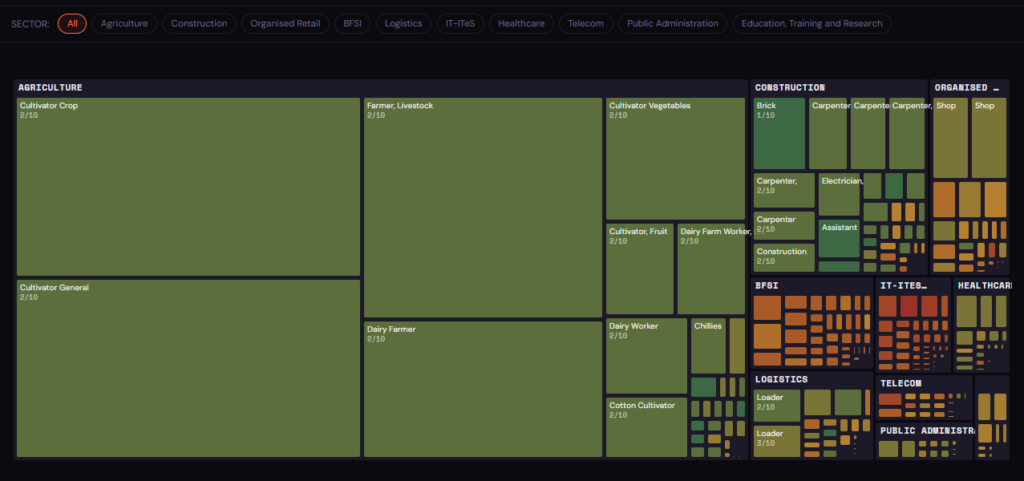
Agriculture dominates. Nearly 40% of India’s workforce is in farming – cultivators, dairy workers, livestock farmers. These jobs score 2–3 out of 10 on AI exposure. They require physical presence, seasonal judgment, and local knowledge that AI cannot replicate at scale, especially in India’s fragmented smallholder farming context. The agriculture block is a massive sea of green.
Construction is the second green giant. With 60+ million workers, construction scores 3/10. Masons, welders, electricians, plumbers – physical skills in unpredictable environments that robots still can’t handle reliably. India’s infrastructure boom under Smart Cities and PM Gati Shakti is creating more of these relatively safe jobs.
IT-ITeS is a small red island. India’s famous software and BPO sector employs far fewer people than agriculture – but scores 7–9 out of 10 on AI exposure. Software developers, data analysts, business process managers, content writers – these are exactly the jobs that LLMs are already eating into. The IT block is tiny but blazing red.
BFSI tells a split story. Bank tellers and loan document processors are highly exposed (7–8/10). Relationship managers and wealth advisors are more protected (5/10) because trust still drives financial decisions in India. The branch banking model that employs hundreds of thousands is under significant pressure.
Telecom is surprisingly high risk. Customer care agents, billing processors, network documentation staff – a huge portion of India’s telecom workforce is in roles scoring 7–8/10. Jio disrupted pricing; AI is disrupting the workforce. Tower technicians and field engineers score much lower (3–4/10) because their work is physical.
Logistics is a tale of two workforces. Delivery workers and warehouse staff score low (2–3/10) – physical work, last-mile human judgment. But dispatch coordinators, route planners, and logistics analysts score 6–7/10. Zomato and Swiggy’s gig economy has created millions of AI-safe delivery jobs while quietly automating the planning layer above them.
Organised Retail is in transition. Cashiers and billing staff score high (7/10) – self-checkout and UPI are already replacing them. But floor staff, visual merchandisers, and store managers score moderate (4–5/10). The kirana store owner scores low – hyperlocal relationships and informal credit systems are hard for AI to replicate.
Public Administration scores higher than people expect. Data entry clerks, document processing officers, and administrative assistants in government score 6–7/10. The institutional inertia of Indian bureaucracy will delay automation, but it won’t prevent it. Millions of aspirational government job seekers are training for roles that AI will significantly reshape within a decade.
Healthcare is the interesting middle ground. Doctors and specialists score moderately (5–6/10) because diagnosis and patient relationships still require human judgment. But medical transcriptionists, billing clerks, and hospital administrative staff score 8–9/10. AI will hollow out healthcare administration long before it touches clinical care.
Education sits in the amber zone. With 10 million+ teachers in India, education scores 4–5/10. The human relationship at the core of teaching is protective – but administrative staff, content creators, and exam evaluators score much higher.
The uncomfortable takeaway
India has spent 30 years building an economy on the back of knowledge work IT services, BPO, back-office processing that is precisely what AI automates best. Meanwhile, the jobs employing most Indians farming, construction, delivery are safe not because they’re valuable but because they’re physical and informal.
Construction workers building smart cities. Delivery workers powering e-commerce. Farmers feeding a billion people. All relatively safe from AI.
Software engineers. Bank clerks. Government data entry operators. Call centre agents. All highly exposed.
The map doesn’t have answers. But it makes the question visible.