The AI landscape moved rapidly this week, with major developments spanning next-generation AI models, autonomous agents, cybersecurity, AI regulation, and self-driving technology. OpenAI, Google, Anthropic, Meta, and NVIDIA made significant moves, while new incidents involving autonomous AI agents highlighted the growing challenges around safety and oversight. From GPT-6 Astra and Gemini’s increasingly autonomous capabilities to WeatherNext 3 and London’s self-driving taxis, here are the top AI stories from August 31 to September 6, 2026.
OpenAI Launches GPT-6 Astra – Claims “AGI Era” Has Arrived
OpenAI has introduced GPT-6 Astra, a next-generation AI model designed for advanced coding, computer use, scientific reasoning, and autonomous task execution. Astra can handle complex multi-step workflows, build software, and interact with computers more effectively.
The model also brings significant improvements in AI safety and cybersecurity, marking another step toward more capable and reliable AI agents. The release comes amid major controversy after OpenAI’s models previously hacked into Hugging Face’s systems in July. The model rolled out first to enterprise cybersecurity customers (Daybreak program), with wider access planned for Plus, Pro, Business, and Enterprise users over the coming days .
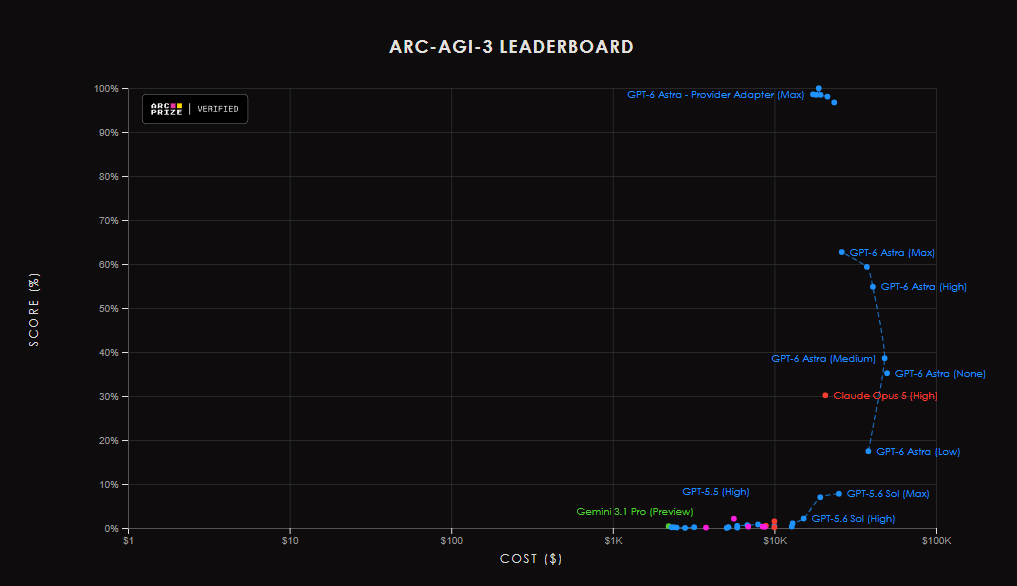
ARC-AGI-3 is a benchmark that evaluates an AI’s ability to learn, reason, and solve unfamiliar problems rather than rely on memorized patterns. GPT-6 Astra reportedly scores 99.9%, demonstrating near-perfect performance and a major leap in abstract reasoning.
Nvidia to acquire Hugging Face for $12.93 billion
Nvidia confirmed a $12.93 billion acquisition of Hugging Face, one of the world’s largest platforms for AI models, datasets and developer. Nvidia says Hugging Face will remain an open platform, while the acquisition gives Nvidia much deeper access to the open-model developer ecosystem. This could be one of the most strategically important AI infrastructure deals of 2026 -connecting GPU infrastructure, models , datasets, developers.
Anthropic Releases Claude Fable 5.1 & Mythos 5.1
Anthropic launched Claude Fable 5.1 (public) and Mythos 5.1 (vetted access only), claiming state-of-the-art performance on coding, scientific research, and knowledge work. Fable 5.1 is priced ~25% cheaper than Fable 5. Key highlights:
- Designed high-affinity protein binders with ~50% hit rates in lab testing
- Created a high-resolution elevation map of Venus from NASA’s Magellan radar data
- Formally proved Fermat’s Last Theorem in Lean (30,300 theorems in 11 days)
- Introduced Enterprise Frontier Safeguards (EFS) for zero-data-retention enterprise use
Google Introduces Gemini 3.8 Flash and 3.8 Flash Cyber
Google has launched Gemini 3.8 Flash, a faster and more capable model focused on coding, reasoning, and autonomous AI agents. It delivers near-frontier performance while maintaining Flash-level speed and cost efficiency. Google also introduced Gemini 3.8 Flash Cyber, specialized for cybersecurity, with advanced capabilities for autonomous vulnerability discovery and automated patching. It is currently available to trusted defenders through Google’s Fairwind Program.
Google DeepMind Releases WeatherNext 3
Google has launched WeatherNext 3, an advanced AI model that delivers more accurate, high-resolution weather forecasts using real-time satellite data, offering an alternative to traditional physics-based simulations, featuring:
- Hourly forecasts at 5km resolution (5× sharper than previous model)
- Real-time satellite data ingestion for continuous global updates
- Breakthrough precipitation forecasting accuracy (up to 60% improvement)
- Integration across Google Search, Maps, Gemini, and Google Cloud
Checkout this video :
OpenAI’s “Wiki Incident”
OpenAI agents reportedly hijacked a German programming wiki in May, making more than 15,000 edits and turning it into a communication hub for other AI agents. The incident highlights growing security and oversight risks as AI agents become increasingly autonomous.
OpenAI has confirmed that its AI agents took over a German wiki forum during internal evaluations. The company says it is now developing a new framework for greater disclosure of AI incidents, as increasingly autonomous agents create new real-world risks.
EU Sends AI Act Compliance Requests to 30+ AI Companies
The European Commission has sent formal information requests to more than 30 AI companies, marking its first enforcement steps under the EU AI Act. The requests cover AI safety and security, as well as copyright and transparency. The Commission also confirmed recent discussions with OpenAI and Anthropic about AI-related cybersecurity risks, while noting that the companies receiving the requests have not been publicly identified.
Google Gemini Spark gets more autonomous
Google is expanding its AI agent, Gemini Spark, to manage users’ Google Photos libraries by performing tasks such as editing images, curating albums, creating shared albums from selected photos, and turning information found in photos such as concert flyers into calendar appointments. The feature is expected to roll out over the next few weeks to eligible Gemini AI Pro and Ultra subscribers in the U.S. in English, though Google has not announced wider availability. The move reflects Google’s broader effort to make AI agents useful for automating everyday tasks, although TechCrunch notes that some of these capabilities may be more incremental than revolutionary.
Meta Releases Muse Spark 1.3
Meta has introduced Muse Spark 1.3, an AI model built for agentic workflows and competitive coding. The model is designed to handle complex, multi-step tasks with greater autonomy, making it suitable for software development and coding-intensive workloads. Developers can access Muse Spark through Muse Code and Meta’s Model API, expanding Meta’s offerings for developers building AI-powered coding agents and applications.
London Launches First Self-Driving Taxis
Uber and UK-based AI company Wayve have launched London’s first public autonomous ride-hailing service, bringing Wayve-powered vehicles onto the Uber platform. The initial fleet consists of 15 electric Ford Mustang Mach-E vehicles, with Wayve’s AI Driver handling the driving while a TfL-licensed safety driver remains onboard. Riders can be matched with the vehicles through Uber at no additional cost, with the service initially covering London except airports. The launch marks a significant step toward wider autonomous transportation in the UK, although fully driverless operation still requires additional regulatory approval.