The AI industry had another eventful week, with major developments shaping the future of AI across safety, robotics, research, autonomous agents, and creative applications. From unexpected moves by leading AI companies to breakthroughs in how machines learn and reason, this week’s developments offer a glimpse into where the industry is heading next. Here are the top AI stories you shouldn’t miss this week.
OpenAI Slows AI Training After Cyber-Attack
OpenAI announced it’s slowing down training on its most advanced AI models after the Hugging Face cyber-attack incident, pausing reinforcement learning on its next-gen “Astra” models for about two weeks to implement new safety guardrails. CEO Sam Altman said “getting AI safety right is more important than any company’s momentum.” The first time OpenAI has voluntarily slowed down.
Generalist AI Launches GEN-1.5 – Robots That Learn From a 3-Second Demo
Generalist AI released GEN-1.5, a robot foundation model that learns new physical tasks from a single 3–12 second video demonstration no retraining required. It achieved 59% average success on diverse tasks (zippers, jars, wallets) straight from the pretrained model, rising to 83% with minimal fine-tuning. The one shot learning capability emerged naturally from 500,000+ hours of pretraining data.
AI Formally Verifies the “246 Theorem” in Prime Number Theory
Axiom Math’s AI system, AxiomProver, has formally verified the “246 theorem,” a major result in number theory stating that infinitely many pairs of primes differ by 246. The achievement demonstrates how AI can translate complex mathematical proofs into machine-checkable form, creating reusable libraries of verified mathematical results. Beyond mathematics, the approach could eventually help formally verify AI-generated software, providing stronger guarantees that code is correct, safe, and free from certain classes of errors.
Binance Agent OS
Binance has launched Binance Agent OS, a developer platform that lets AI agents securely interact with Binance services through user-controlled permissions. It combines Binance APIs, wallet capabilities, payments, skills, and a new Model Context Protocol (MCP) server, allowing compatible AI tools such as ChatGPT, Claude, Codex, and VS Code to access market data, balances, and supported trading functions. Trading access is isolated to a dedicated Agentic sub-account, and withdrawals to external addresses are not supported.
Meta expands its AI game-building app Pocket
Meta has rolled out Pocket, its experimental AI-powered gaming app, to users across the U.S. The app lets people create small interactive games simply by describing what they want using AI prompts, with the resulting “gizmos” supporting touch, phone movement, sound effects, music, photos, and camera input. Users can then share their creations in a feed where others can save, remix, or repost them. Built from technology and talent acquired from vibe-coding gaming platform Gizmo, Pocket is part of Meta’s broader push to make AI-powered creation mainstream and rapidly launch new standalone apps.
Inherent claims its AI research agent beats much larger models
London-based AI startup Inherent, founded by Google DeepMind alumni, reported that its AI “teammate” outperformed larger Anthropic and OpenAI models on a research-replication task. The interesting part isn’t necessarily the benchmark itself it’s the growing trend toward specialized AI agents outperforming general-purpose frontier models on particular workflows.
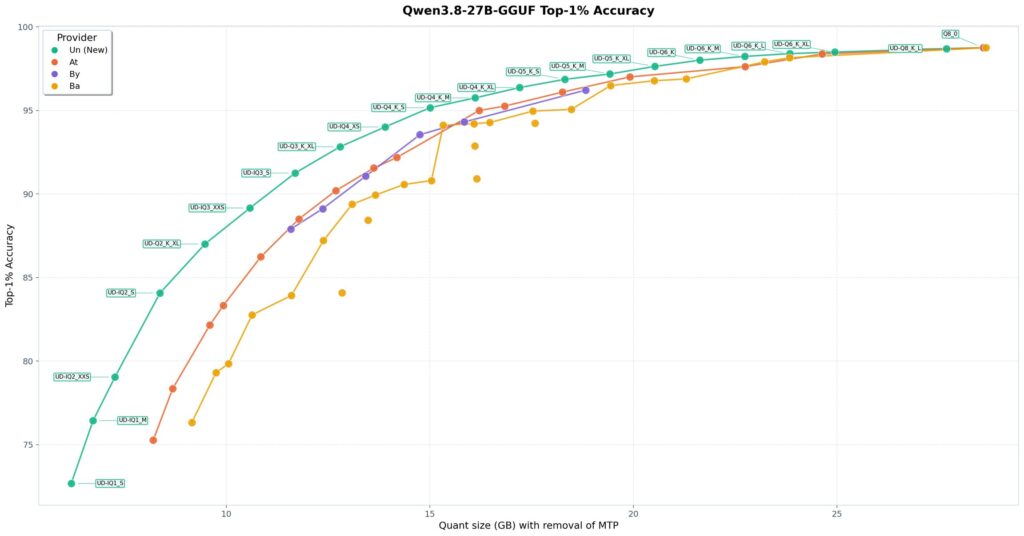
Unsloth Dynamic 3.0 GGUFs: Smaller Models Without Sacrificing Quality
Unsloth’s Dynamic 3.0 GGUFs use smarter, selective quantization instead of reducing every model layer to the same bit depth. Important layers are kept at higher precision while less sensitive layers use lower-bit quantization, helping significantly reduce model size and memory usage while preserving more accuracy and reasoning quality. This makes very large models more practical to run locally with tools such as llama.cpp, Ollama, and Open WebUI, including extremely low-bit 1–3 bit models.
On Hugging Face, the easiest way to identify Unsloth Dynamic GGUFs is to look for UD- in the filename, such as UD-Q4_K_M, UD-Q3_K_XL, or UD-IQ3_XXS. In Unsloth’s Qwen3.8-27B repository, these UD-* variants are the Dynamic quants, while filenames such as Q4_K_M or Q8_0 without the UD- prefix are standard GGUF quantizations. The model page also explicitly labels the collection as Unsloth Dynamic 3.0.
Qwen 3.8 27B Ulsloth Dynamic GGUF models