
This week saw several major AI announcements from leading companies, with a strong focus on larger open models, improved AI safety, and more powerful multimodal capabilities. Moonshot AI introduced its massive Kimi K3 model, OpenAI unveiled GPT-Red for automated AI security testing, Thinking Machines released the new Inkling open-weight model, xAI moved Grok 4.5 into private beta, and Alibaba announced the upcoming Qwen3.8. Here’s a quick look at the biggest AI developments from the past week.
China’s Moonshot AI Releases Kimi K3
The biggest story of the week. Beijing-based Moonshot AI (backed by Alibaba and Tencent) launched Kimi K3, a 2.8-trillion-parameter multimodal model with a 1-million-token context window and native vision. It’s positioned as the world’s largest open-weight model, with full weights scheduled for release on July 27.
- Benchmarks: Ranked #1 on Arena.ai’s Frontend Code Arena, beating Claude Fable 5 and GPT-5.6 Sol. Second overall behind Fable 5 Max on real-world task benchmarks (Artificial Analysis). State-of-the-art on
BrowseComp (91.2/100). - Architecture: Uses Kimi Delta Attention (hybrid linear attention) and Attention Residuals. 16 of 896 experts active per token.
- Pricing: $0.30/M input tokens (cached), $3/M uncached, $15/M output significantly cheaper than U.S. rivals.
- Agentic demo: Designed a functional 4 mm² chip in 48 hours of autonomous operation using open-source EDA tools.
OpenAI Launches GPT-Red
OpenAI has unveiled GPT-Red, an automated AI red-teaming model designed to stress-test its own systems before public release. Specializing in prompt injection attacks where malicious instructions trick AI models into exposing data or performing unauthorized actions GPT-Red uses self-play reinforcement learning to continuously discover new vulnerabilities and harden production models like GPT-5.6 Sol. The initiative arrives amid rising concerns over the security of frontier AI systems, with the Trump administration recently introducing a voluntary quarantine policy for model evaluations. While OpenAI and competitors like Anthropic are increasingly automating safety testing to build trust, industry experts warn that enterprises shouldn’t rely solely on vendor red-teaming and should still conduct their own due diligence to ensure AI tools align with their specific security and business workflows.
Thinking Machines Lab Releases Inkling
Thinking Machines released Inkling, a 975-billion-parameter Mixture-of-Experts model (41B active parameters) with a 1M-token context window, native multimodal support (text, image, audio), and controllable thinking effort for balancing cost vs. performance.
- Available for fine-tuning on the Tinker platform.
- A smaller variant, Inkling-Small (12B active), also previewed.
- Trained on NVIDIA GB300 NVL72 systems with 30M+ RL rollouts
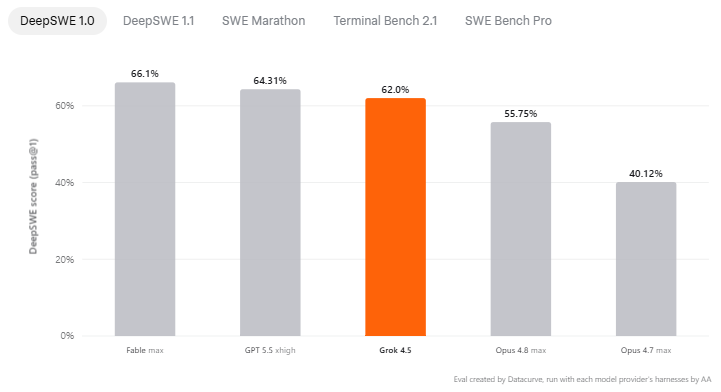
xAI Launches Grok 4.5 into Private Beta
Elon Musk announced that xAI has officially advanced its frontier capabilities by pushing Grok 4.5 into private beta testing within SpaceX and Tesla ecosystems. Built on a massive 1.5-trillion-parameter foundation architecture, this new iteration is three times larger than the model handling production traffic on the X platform, and represents a 50% jump in scale from Grok 4.4, which rolled out only a month prior. Early internal benchmarks indicate that the model is rapidly closing the performance gap with the industry’s topmost frontier models.
Qwen3.8 is Coming: 2.4T Parameters
Alibaba has announced the upcoming open-weight launch of Qwen3.8, a massive 2.4-trillion-parameter AI model. Positioned as one of the most powerful models currently available second only to Fable 5 it is designed to compete with leading frontier AI models. While the full open-weight release is coming soon, users can immediately test the model via the Qwen3.8-Max-Preview, which has just debuted on Alibaba’s Token Plan, Qoder, and QoderWork platforms.
UN Deploys AI to Accelerate Global Methane Mitigation
The UN Environment Programme (UNEP) published a groundbreaking report detailing how artificial intelligence is being successfully leveraged to combat climate change. Utilizing the AI-driven Methane Alert and Response System (MARS), the UN has successfully processed vast feeds from over 30 satellites, enabling analysts to identify major industrial gas leaks 12 to 15 times faster than humanly possible. Crucially, the UN highlighted that the AI models were designed to be lightweight and energy-efficient, proving that advanced machine learning can drive environmental action without imposing a massive carbon footprint of its own.