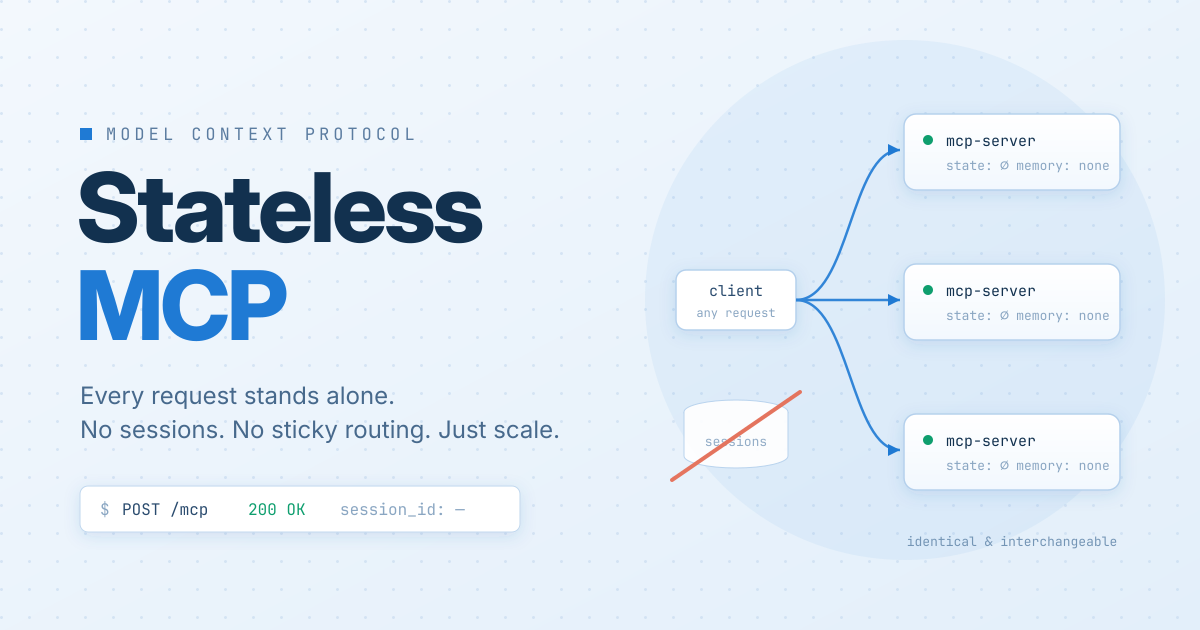
The Model Context Protocol (MCP) has quickly become the standard way for AI assistants and applications to communicate with external tools, APIs, databases, and services. It provides a common interface that allows AI models to access capabilities without requiring custom integrations for every application. The latest evolution of MCP introduces stateless communication, a significant architectural shift that makes MCP deployments more scalable, reliable, and cloud-native.
In this article, we’ll explore what stateless MCP is, why it matters, how it differs from the earlier approach, and what benefits it brings to AI application developers.
What is the Model Context Protocol (MCP)?
Model Context Protocol (MCP) is an open protocol that standardizes communication between AI models and external systems. Instead of building separate integrations for every AI model, developers create an MCP server exposing tools such as:
- Database queries
- File operations
- Git repositories
- Web APIs
- Enterprise systems
- Internal business applications
Any MCP compatible AI client can then invoke these tools using the same protocol. This greatly simplifies AI integration across different models and platforms.
How Earlier MCP Worked
Earlier MCP implementations primarily relied on:
- Standard Input/Output (stdio)
- HTTP streaming
In many deployments, the MCP server maintained session state. For example:
- Client opens a connection.
- Server creates a session.
- Session stores conversation context.
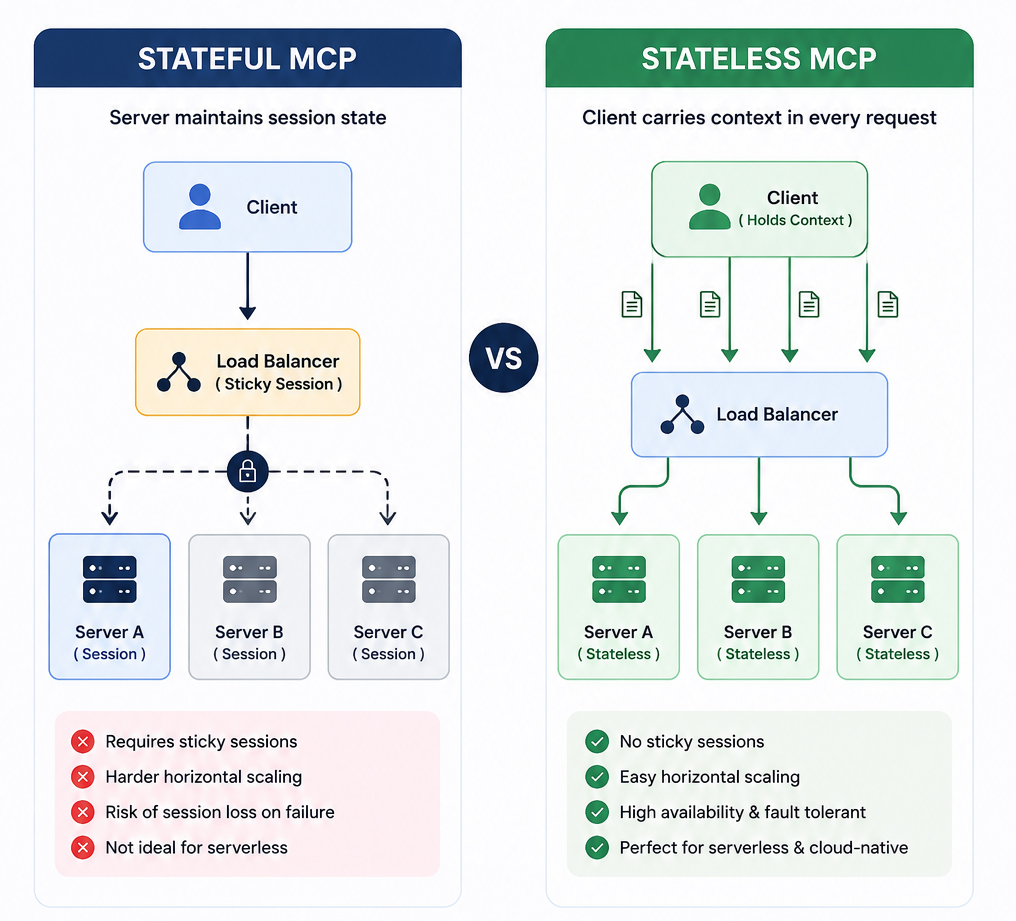
- Future requests must reach the same server instance.
This worked well for local applications but introduced several challenges for distributed cloud deployments.
The Problems with Stateful MCP
Maintaining session state creates operational complexity.
1. Sticky Sessions
A user’s requests must always reach the same server instance. If the next request reaches Server B instead of Server A, the session is missing. This forces infrastructure teams to configure sticky sessions, reducing the effectiveness of load balancing.
2. Limited Horizontal Scaling
Suppose your AI application suddenly receives 50,000 simultaneous users. With stateful sessions:
- Existing sessions cannot easily move.
- Adding new servers doesn’t automatically distribute active users.
- Some servers become overloaded while others remain underutilized.
Scaling becomes significantly harder.
3. Server Failures
Imagine Server A crashes. Every active session stored on that server disappears. Users may need to reconnect or lose in-progress work unless additional session replication mechanisms are implemented.
4. Serverless Isn’t Ideal
Serverless platforms such as AWS Lambda,Google Cloud Run,Azure Functions are designed around independent requests. Stateful connections conflict with this execution model because functions are temporary and shouldn’t retain user-specific state.
Stateless MCP Changes Everything
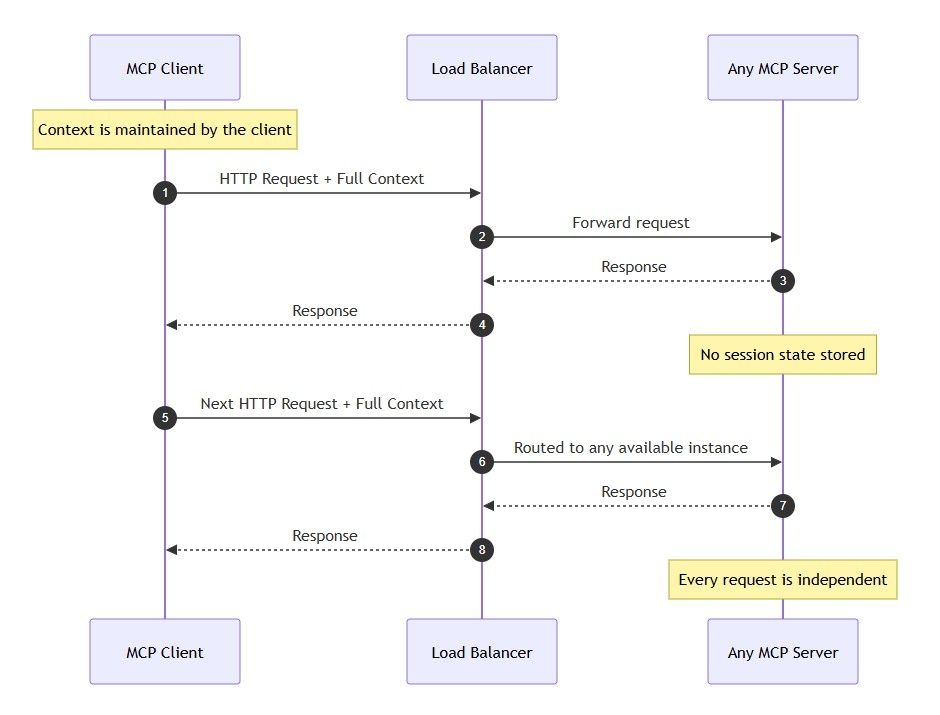
The new stateless architecture shifts session responsibility from the server to the client. Instead of the server remembering previous interactions, each request contains everything required to process it. The server simply:
- Receives a request.
- Processes it.
- Returns a response.
- Forgets everything.
Every request is independent.
Why This Matters
1. Easy Horizontal Scaling
Adding new servers becomes straightforward. Since no server owns user sessions, any instance can process any request. Cloud platforms can automatically scale based on traffic.
2. Better Load Balancing
Without sticky sessions:
- Requests distribute evenly.
- Infrastructure utilization improves.
- Hotspots are minimized.
- Performance becomes more predictable.
3. Improved Reliability
If one server fails, the client simply sends the next request to another server. No session recovery is needed.
4. Perfect for Serverless
Stateless MCP aligns naturally with serverless computing. Platforms such as AWS Lambda, Google Cloud Run, and Azure Functions are designed for independent request processing.
5. Simpler Infrastructure
Removing server-side session management also eliminates the need for:
- Session databases
- Session replication
- Sticky load balancers
- Distributed session synchronization
This reduces operational complexity and lowers maintenance overhead.
What Moves to the Client?
In a stateless architecture, the client is responsible for maintaining the information needed across requests. Depending on the application, this may include:
- Conversation history
- Tool invocation context
- Authentication tokens
- User state
- Any metadata required for the next request
Each request includes the necessary context, allowing the server to process it independently.
Conclusion
The move toward stateless Model Context Protocol represents an important step in making AI infrastructure more scalable and cloud-ready. By shifting session responsibility from the server to the client, MCP enables simpler load balancing, effortless horizontal scaling, improved fault tolerance, and seamless deployment on modern serverless platforms.