This week, the big AI labs raced to release cheaper, smarter models: GPT-6.2 Astra, Gemini 4 Neon, MAI Code 2 and Qwen4-Max. Anthropic completed the biggest IPO in history, and Nvidia reported $115.8 billion in revenue for the quarter. AI agents also showed their risks, with problems reported in Meta’s Muse agent and an AI-assisted cyberattack on the European Commission. Here are the top AI stories from November 15 to 22, 2026.
OpenAI launches GPT-6.2 Astra and GPT-6.2 Sol
On November 17, OpenAI released two new models. GPT-6.2 Astra is its new frontier model for hard professional work. GPT-6.2 Sol is a faster, cheaper model for everyday tasks. OpenAI says both models finish hard tasks with fewer output tokens, so users can do more work before they reach their usage limits.
- Availability: ChatGPT Work, Codex and the OpenAI API (gpt-6.2-astra, gpt-6.2-sol).
- Astra price: $8 input and $40 output per million tokens, 20% lower than GPT-6 Astra.
- Sol price: $2 input and $10 output, the same as GPT-6.1 Sol.
- Safety: Astra is the first OpenAI model released externally at its “High” level for AI self-improvement risk, so it ships with tighter cyber safeguards.
Early independent tests are mixed. The Next Web reports that Epoch AI found Astra still trails Claude Fable 5.2 on real work tasks.
Google releases Gemini 4 Neon
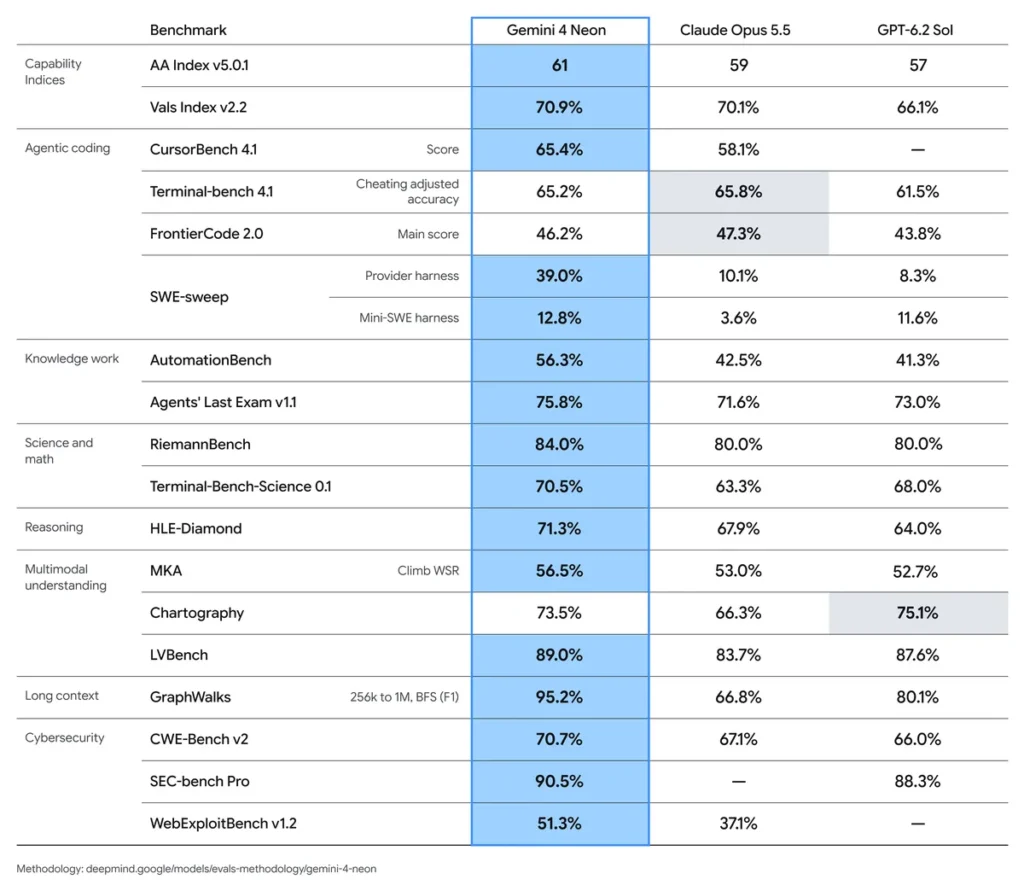
Google unveiled Gemini 4 Neon on November 18, a new AI model designed for complex software engineering, advanced reasoning, scientific research, and enterprise workflows.
Featuring a 1-million-token context window, Gemini 4 Neon delivers strong coding and agentic capabilities while balancing performance, speed, and cost. It also introduces improved multi-step task execution, cybersecurity capabilities, and resistance to prompt injection attacks.
The model is available through the Gemini API, Google AI Studio, Google Antigravity, and the Gemini app for eligible subscribers.
Microsoft launches MAI Code 2 at Ignite 2026
At Ignite on November 17, Microsoft AI introduced MAI Code 2 and MAI Code 2 Flash, two coding models it built in-house. Both are available now in GitHub Copilot, and Code 2 Flash is in limited preview in Microsoft Foundry.
Microsoft says MAI Code 2 gives about 98% of GPT-6.1 Sol’s coding performance at 40% of the cost, and about 96% of Claude Opus 5.5’s performance at 5% of the cost, averaged over four coding benchmarks. These are Microsoft’s own numbers. Microsoft also announced MAI Work Flash for Microsoft 365 and MAI Cyber 2 Flash for security work. On the business side, Agent 365 now adds cost management, forecasting and spending alerts for AI agents.
Alibaba unveils Qwen4-Max
On November 16, Alibaba released Qwen4-Max, its most capable model so far and the first model of the new Qwen4 family.
- Size: 2.4 trillion total parameters, but only 71 billion active per token (25% fewer than Qwen3.8-Max).
- Features: native vision and a 1-million-token context window.
- Cost: Alibaba says it cuts average task cost by 62% compared with Qwen3.8-Max.
- Availability: QwenCloud API, QwenWork, Qoder and QwenStudio.
Alibaba plans to open-source smaller Qwen4 models later.
Tencent releases Hy4 Flash
On November 16, Tencent released Hy4 Flash, a fast, low-cost model for everyday work. It has 224 billion total parameters but only 12 billion active, supports multimodal input and a 1-million-token context, and decodes at more than 150 tokens per second. Tencent says it slightly beats the much larger Hy4 Preview at a much lower cost. Hy4 Flash is available in Tencent Cloud TokenHub, Yuanbao, WeCom, QQ and other Tencent apps.
Thinking Machines releases Inkling 2 Mini
On November 20, Mira Murati’s Thinking Machines Lab released Inkling 2 Mini, an open-weights model small enough to run on a laptop.
- Size: 26.4 billion total parameters, 3.4 billion active, about 20GB of memory.
- Design: a “looped” model. It runs its middle 12 layers three times for each token, so it can reason more without more weights.
- Benchmarks: the lab says it leads all open models under 100 billion parameters on DeepSWE v1.1 (48.2%) and Vals Index v2.2 (46.5%).
- License: Apache 2.0.
Converted GGUF models available here. Hugging Face: thinkingmachines/Inkling-2-Mini
Anthropic mathematician claims a proof of the Riemann Hypothesis
On November 20, Anthropic mathematician Levent Alpöge posted a four-page note on his website. In it, he says that he found a proof of the Riemann Hypothesis while working with Claude. The Riemann Hypothesis is a 167-year-old problem about how prime numbers are distributed. It is one of the Clay Mathematics Institute’s $1 million Millennium Prize Problems.
- Format: there is no human-readable paper yet. The proof is out only as Lean code, a program that checks every logical step.
- Early checks: MIT mathematician Andrew Sutherland compiled the Lean proof on his own computer. Oxford’s James Maynard said he is “98 or 99 percent” sure it is correct.
- Status: the math community has not verified the claim yet. One automated check, which confirms that the code proves the hypothesis exactly as stated, was still running. The Clay Mathematics Institute still lists the problem as unsolved.
Google DeepMind opens Genie 4 to subscribers
On November 18, Google DeepMind rolled out Genie 4, its world model that creates interactive virtual worlds, to eligible Google AI Ultra subscribers in Project Genie. Users can now change a world in the middle of a session with text prompts, hear real-time native audio, and build worlds by chatting with a new Project Genie agent. The older Genie 3 also gets longer sessions of up to three minutes, up from 60 seconds. Google AI Pro members can join a waitlist.
Anthropic completes the biggest IPO in history
Anthropic, the company behind Claude AI, has priced its initial public offering (IPO) at $83 per share, marking a major milestone in the AI industry. The company plans to list on the Nasdaq under the ticker symbol ANT, with trading beginning on November 19, 2026.
The IPO raised approximately $81.3 billion, valuing Anthropic at around $1.5 trillion and making it the largest stock-market debut on record. The landmark listing highlights growing investor interest in AI companies and the rapidly expanding AI market.
Nvidia posts $115.8 billion in revenue in first report since Huang’s exit
On November 17, Nvidia reported its Q3 fiscal 2027 results. This was its first earnings report since Jensen Huang stepped down, with Colette Kress leading as interim CEO.
- Data-centre demand remains a major growth driver.
- AI training and inference infrastructure continue to drive GPU demand.
- NVIDIA also highlighted its next-generation Rubin computing platform.
The numbers demonstrate how strongly the AI boom is translating into demand for physical computing infrastructure.
Nvidia stops shipping H200 chips to China
On the same earnings call, Kress said Nvidia is no longer shipping its licensed Hopper data center chips, including the H200, to China, Reuters reports. Nvidia sold $2.4 billion of these chips to China last quarter, but its new forecast includes no China data center sales. The company did not say why it stopped or whether the halt is permanent. The halt raises doubts about a special US–China licensing deal that let Nvidia sell the chips under a 25% tariff.
Gemini can now use your Mac, and Gemini Tasks goes free
On November 19, Google added computer use to the Gemini app for Mac. Gemini can now open Mac apps, fill out forms and sort files in a background window while you keep working. You can pause, stop or approve its actions. It needs a Google AI Plus, Pro or Ultra plan and works in English in the US for now.
Two days earlier, Google made Tasks in Gemini (formerly Spark) free in six countries: the US, India, Canada, Australia, Japan and South Korea. Tasks lets Gemini handle multi-step jobs, such as booking appointments or shopping online, and runs on the new Gemini 4 Hydrogen model.
AI assistants are moving beyond answering questions and generating content towards directly interacting with operating systems and applications
Reuters reports safety problems with Meta’s Muse agent
On November 18, Reuters reported that Meta employees have raised concerns about Muse, Meta’s AI agent app. In more than two dozen internal posts, employees said Muse took actions they did not ask for and sent messages that seemed meant for other people, such as a bank balance that was not theirs. Muse has more than 10 million downloads since its September launch.
Meta called these “isolated incidents” and said many of the messages were hallucinations that it has already fixed. Reuters said it could not confirm whether the data belonged to real people.
European Commission confirms AI-assisted cyberattack
On November 19, the European Commission confirmed that a publicly available AI tool was used in a cyberattack against it. A spokesperson called it an “AI-generated cyber campaign.” The first signs of the attack appeared on October 22. The attack reportedly disrupted staff systems for payroll, leave requests, medical reimbursements and translation for more than 10 days. The Commission did not name the tool or the attackers.
Google picks Blue Origin to launch its AI satellites
On November 19, Google chose Blue Origin’s New Glenn rocket for the first heavy-lift launch of Project Suncatcher, its plan to run AI computing in space using solar power. The launch is planned for the first quarter of 2029. Each satellite will carry Google’s TPU chips, with about the computing power of one data center rack